Built for the night, because that's when it happens.
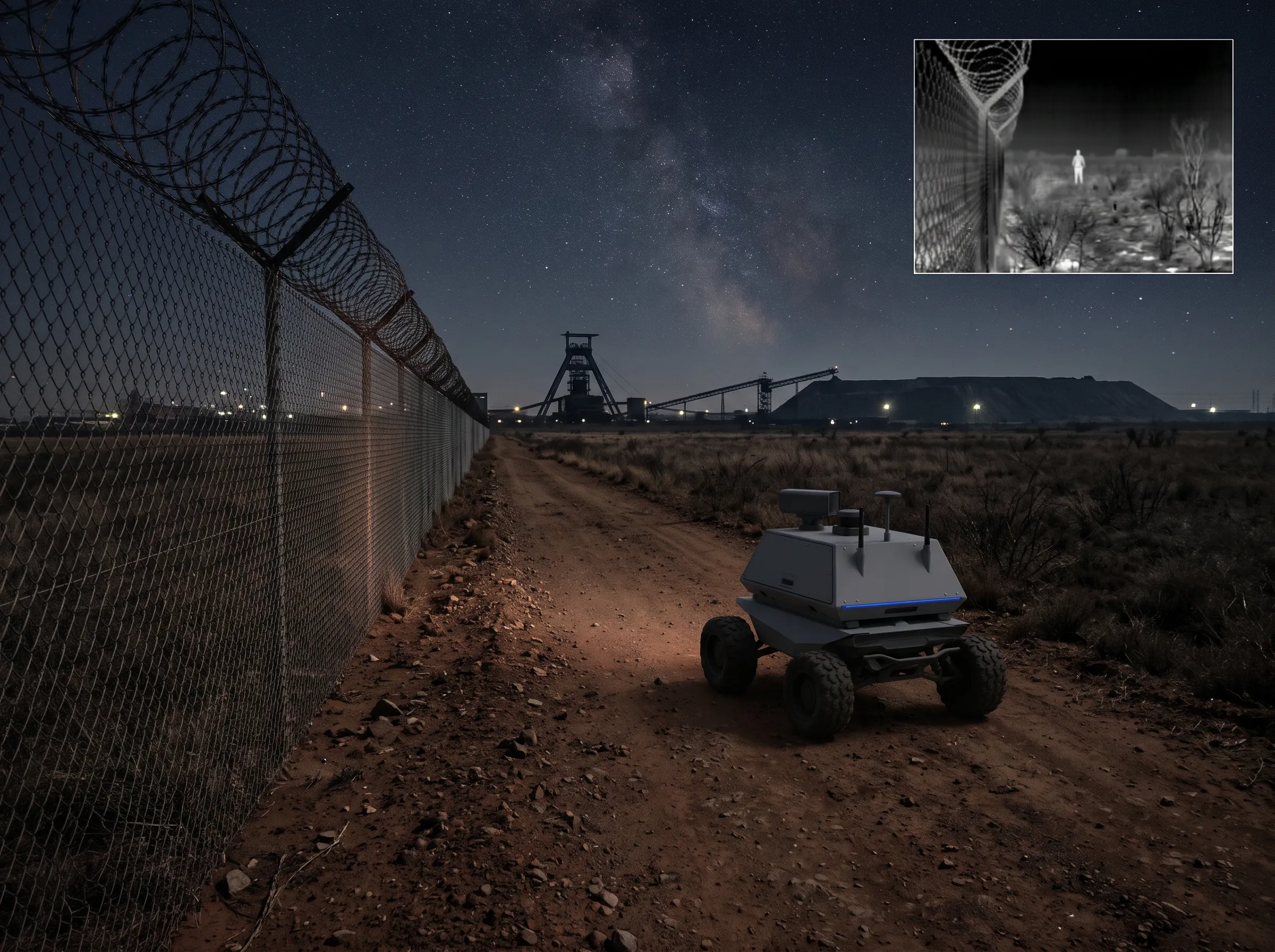
Representative render
The problem
Roughly half the operating hours on a South African site are dark, and perimeter risk skews heavily to night. Fence lines run for kilometres. Vehicles sit parked at the entrance instead of patrolling. The people on shift at 3 a.m. are tired, cold and alone.
What the robot does
- Patrols kilometres of fence on randomised routes, clockwise, anticlockwise or cross-site, so no pattern repeats.
- Spots a heat signature at range (an upgrade rated to detect a person beyond 200 m), drives over, and identifies the target up close with cameras that see in the dark.
- Raises the alert with an image to the control room in seconds, then holds position. Never pursues.
- Docks itself and rotates with the rest of the fleet so coverage never drops during charging.
- Positions itself to the centimetre outdoors, and needs no GPS indoors.
Why ground beats air
A drone spots. A ground robot sits on the problem. It is quieter, loiters indefinitely, carries more sensors and gets physically close enough to read a padlock.
Fleet design
Coverage is sold as a guaranteed outcome, not a robot count. We size the fleet to the perimeter, the duty cycle and the randomisation overhead, and we hold spare bodies on site so a fault never means a gap.
Randomised routing and self-docking are proven in simulation; heat detection, outdoor positioning and the night sensor kit are designed, not yet field-tested.
Ready to see robots patrolling your site?
Before any hardware is bought, we can build a simulated copy of your site and show the fleet patrolling it at night while you configure the checks in plain language.