Ten kilometres of fence. Zero predictable gaps.
For: mine managers and finance, who carry the security budget and the losses from cable theft, illegal mining and fuel.
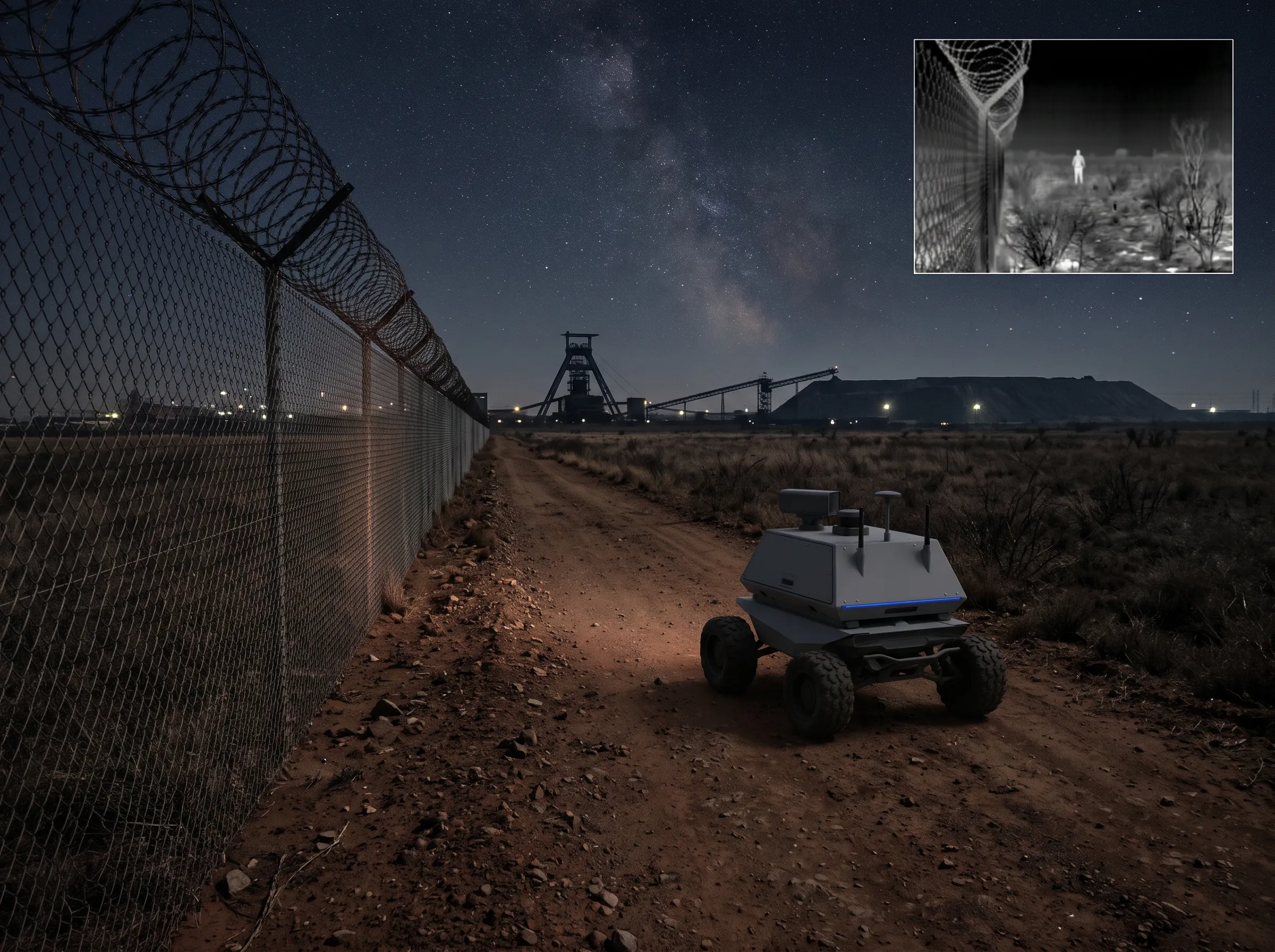
Representative render
The context
South African mine security is surface work: perimeters, access control, plants, yards and fence lines. Illegal mining, cable theft and armed intrusion. Half the hours are dark. The patrol layer is often the weak point, and the bakkies spend more time at the gate than on the fence.
The argument is integrity, not savings
At matched coverage a robot fleet costs about the same as the guards and vehicles it replaces. What changes is who is on the fence. A robot can't be bribed, threatened or tipped off, on a site where most theft is inside-enabled. It patrols near 100% of its scheduled hours, takes a different route every time, and photographs every check. And it puts fewer of your people on a dark fence line facing armed intruders.
The hybrid model
Robots do all patrolling, detection and inspection. The mine keeps one manned response vehicle for close inspection, arrest and verified incidents. Nobody is asked to fire anyone. The mine stops paying for patrolling that sits at the gate and keeps humans where judgement and force are needed.
What the fleet does
- Patrols the full perimeter continuously on randomised routes, clockwise, anticlockwise or cross-site.
- Detects heat signatures at range, closes in, and identifies in the dark.
- Checks the fuel store, substations, gates and fence sections at every pass with a photographed verdict.
- Docks itself on MoLogica docks placed around the perimeter and rotates so several robots are always on the fence.
- Raises verified alerts to your control room. Your response vehicle attends. The robot never pursues.
What you get
Industrial wheeled tier, with legged bodies where terrain demands.
- Full perimeter patrolled continuously on randomised routes, day and night
- Several robots on the fence at all times, sized to your loop length
- Heat detection of a person beyond 200 m at night, close identification in the dark
- Centimetre-accurate outdoor positioning
- Waypoint checks: fuel store, substations, gates, fence sections, vehicle yard counts
- Alert with image to your control room; robot holds position, never pursues
- All-weather bodies with suspension, around 3 hours per charge, self-docking around the perimeter
- Spares held on site; a robot off-route or off-link is itself an alert
- Subscribe to coverage, or buy outright with a service plan
Fleet design is modelled; patrol, routing and docking are proven in simulation on indoor bodies; outdoor bodies, heat detection and positioning are not yet field-tested.
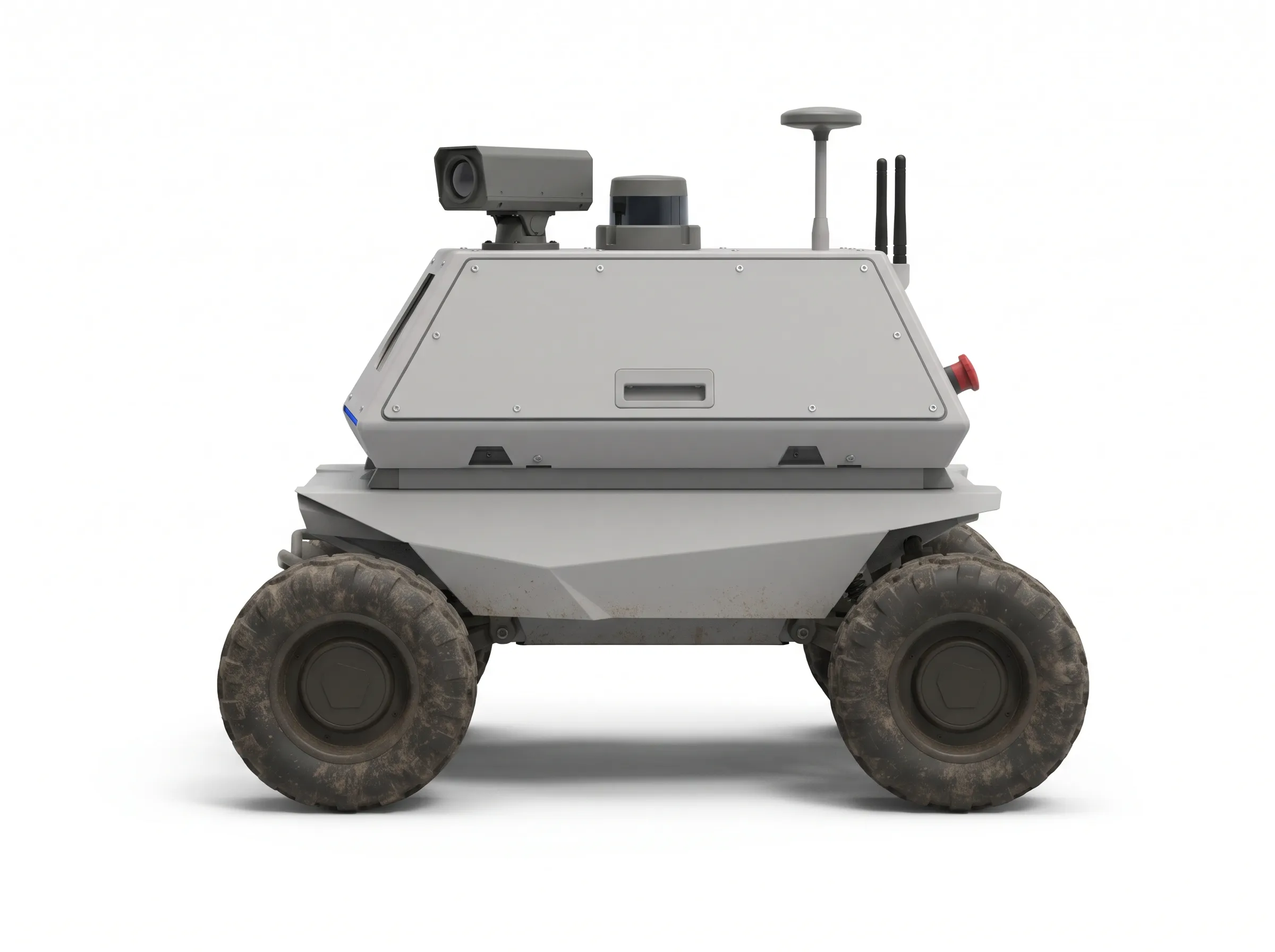
Representative render
Robot theft is a design constraint
Exposed perimeter bodies report position and status continuously. One that goes off-route or loses its link is itself an alert.
Simulate it first
From satellite and elevation data, plus the drone or survey scans most mines already have, we build a twin of your perimeter and show the fleet patrolling it at night before any hardware is ordered. Then the fleet learns your actual fence from day one.
Ready to see robots patrolling your site?
Before any hardware is bought, we can build a simulated copy of your site and show the fleet patrolling it at night while you configure the checks in plain language.